Updated August 27, 2026
How to turn an SVG into a 3D logo
An SVG is the best file to start from: 3DLogo.io reads its paths directly, extrudes them to a depth you set, and applies a material, so the finished 3D logo has exactly the outline your vector file had. Upload the SVG in the editor, pick a finish such as chrome, gold, or glass, and export a PNG, a GLB, or an MP4 loop.
The mechanism matters because it explains the quality difference. An SVG already describes the mark as mathematical curves. The editor converts those curves to a mesh and pushes it along the depth axis, so edges stay sharp at any size and a bevel can be cut cleanly. Nothing is guessed. A PNG or JPEG has to be traced into curves first, which is an estimate of where the edges were.
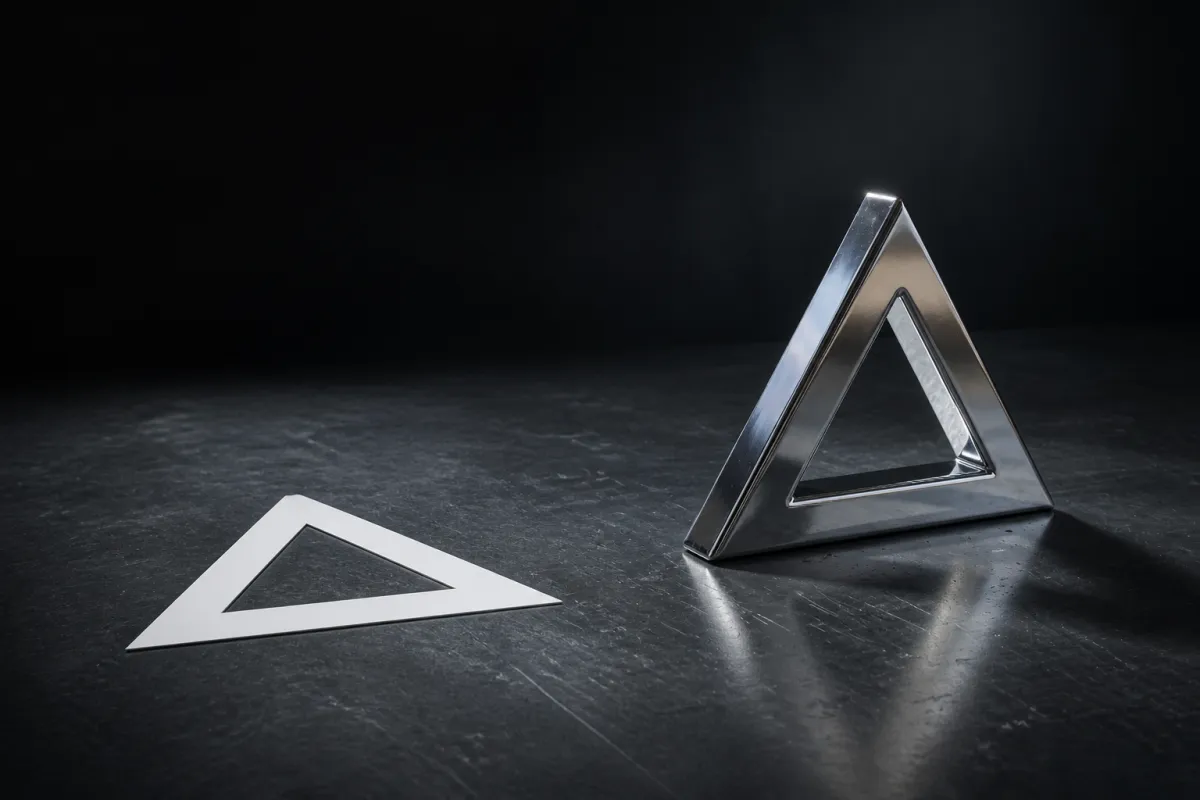
What the SVG must contain
| Requirement | Why, and what to do |
|---|---|
| Paths, not text | Live text in an SVG has no outline to extrude. Convert type to outlines before exporting (Illustrator: Type > Create Outlines; Figma: Flatten; Inkscape: Path > Object to Path). If the file has no drawable shape the editor reports that no shapes were found. |
| Under 1 MB | SVG uploads are capped at 1 MB. A logo almost never needs more; a file that large usually contains an embedded raster image or thousands of trace points from an auto-vectorised photo. |
| No embedded scripts or external references | The SVG is parsed in your browser, so anything that could run code or fetch a remote resource is refused rather than rewritten: script, foreignObject, XML entities, inline event handlers, javascript: URLs, iframe, object, embed, meta, link, external href values, and @import or remote url() styles. Export a plain paths-only SVG. |
| Roughly 50 paths or fewer | Path count drives mesh size. Five or fewer is optimal, up to 20 performs well, 21 to 50 may be slow on older phones, and above 50 the editor refuses the file because the mesh would stall the browser. Merge overlapping shapes and delete hidden layers to bring the count down. |
| A real viewBox | The mark is fitted to the canvas from the viewBox. A file exported at 4000 px or more with no viewBox can arrive scaled oddly; set the artboard tight to the mark before export. |
How to export an SVG that works
- Illustrator: select the artwork, Type > Create Outlines, then Object > Path > Clean Up to drop stray points. File > Export > Export As > SVG, styling set to Presentation Attributes, and turn off Responsive so a viewBox is written.
- Figma: select the frame, right-click > Flatten if any live text remains, then Export > SVG with "Include id attribute" off and "Outline text" on.
- Inkscape: Path > Object to Path on the whole selection, then File > Save As > Plain SVG (not Inkscape SVG, which carries extra editor metadata).
- Any tool: if the mark has a knockout or counter (the hole in an "O" or an "A"), keep it as a compound path so the hole survives extrusion instead of filling in.
How to make it on 3DLogo.io
- Open the editor. No account is needed to start.
- Drop the SVG on the upload panel, or use the Upload button.
- Pick a material preset: chrome, gold, glass, holographic, brushed metal, or a gradient.
- Set depth and bevel, then choose an environment and background. Add motion if the logo will move.
- Export a PNG for stills, a GLB or glTF to keep the 3D model, OBJ or STL for desktop tools and printing, or an MP4 loop.
Conditions and limitations
A single-colour extrusion is what an SVG upload produces. Per-path colours in the source file are not carried through as separate materials; the whole mark takes the chosen preset. Gradients, blend modes, filters, and clipping masks in the SVG are ignored, so bake any of those into the shape beforehand or accept the flat outline. Free exports carry a small 3dlogo.io mark and cap stills at 1024 px and video at 480p.
If a file is refused or the result looks wrong, the troubleshooting page lists every message the editor can show and the fix for each.
Questions
- Can you turn any SVG into a 3D logo?
- Any SVG that is under 1 MB, contains drawable paths rather than live text, has no scripts or external references, and stays near or below 50 paths. Those four conditions cover almost every exported brand mark. Photos that were auto-traced into thousands of paths are the common exception.
- Why does my SVG upload but show nothing?
- The usual cause is live text that was never converted to outlines, so the file parses correctly but has no shape to extrude. The second cause is artwork sitting outside the viewBox. Convert type to outlines and crop the artboard to the mark, then re-export.
- Does the hole in a letter stay open in 3D?
- Yes, when the counter is part of a compound path with the correct fill rule, which is what every design tool writes by default. If a hole fills in, the counter was exported as a separate overlapping shape; select both and make a compound path before exporting.
- Is SVG better than PNG for a 3D logo?
- Yes, when you have the choice. SVG paths extrude to the exact outline, so edges and bevels stay sharp at any export size. A PNG must be traced first, which approximates the edges and depends on contrast. Use a PNG only when no vector file exists.
- Does it cost anything?
- No. The editor, every material preset, and PNG, GLB, OBJ, STL, USDZ, and 480p MP4 export are free without an account. Free exports carry a small 3dlogo.io mark. Pro removes it and adds 2K and 4K stills and 720p or 1080p video.